What Is SLA in Customer Support?
What an SLA means in customer support, the difference between first response and resolution targets, business hours, how to define realistic targets and how to measure compliance.
SLA stands for service level agreement. In customer support, it is a commitment about how quickly requests will be handled, usually how fast the first answer arrives and how fast the problem is resolved. An SLA can be a formal clause in a contract with a customer, or an internal target the team sets for itself. Either way, it turns "we answer quickly" into something specific and measurable.
The two most common SLA targets
First response time
The time between the moment a ticket is opened and the first public reply from the support team. Automatic acknowledgements ("we received your request") usually do not count; the point is a human reply that moves the case forward.
Resolution time
The time between the moment a ticket is opened and the moment it is marked as resolved. Some teams pause this clock while waiting for the customer; others measure the full elapsed time and report waiting time separately. Whatever you choose, be consistent and explain it.
Business hours vs. calendar time
Targets can count every hour of the day (calendar time) or only business hours. Business hours are the norm for most teams that do not work around the clock.
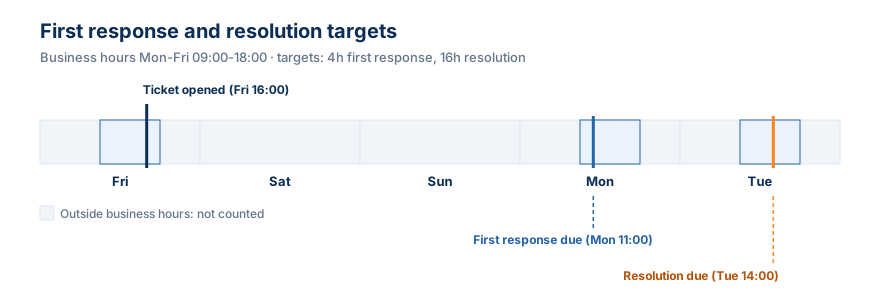
In the example above, the team works Monday to Friday, 09:00 to 18:00. A ticket opened on Friday at 16:00 with a 4-hour first response target is due on Monday at 11:00 (two hours on Friday and two on Monday). With a 16-hour resolution target, it is due on Tuesday at 14:00. Weekends and nights are not counted.
If you promise 24/7 support for urgent issues, use calendar time for those priorities only.
SLA targets by priority
Not every request deserves the same speed. Targets are normally set by priority:
| Priority | First response | Resolution |
|---|---|---|
| Urgent | 1 business hour | 8 business hours |
| High | 4 business hours | 2 business days |
| Normal | 8 business hours | 5 business days |
| Low | 2 business days | 10 business days |
This table is an illustration, not a recommendation. Your targets depend on what your customers need, what your contracts say and how many people you have.
SLA, SLO and OLA
You may see related acronyms:
- SLA (service level agreement): the commitment made to the customer or user.
- SLO (service level objective): the specific measurable target inside an SLA, such as "first response within 4 business hours for high priority".
- OLA (operational level agreement): an internal agreement between teams that supports the SLA. For example, the infrastructure team commits to answering escalations from support within 2 hours.
Small teams rarely need all three. Clear targets by priority, measured consistently, are enough.
How to define realistic targets
- Measure first. Look at the last one to three months. What are your current median first response and resolution times by priority?
- Start near reality. Set targets your team already meets most of the time. Ambitious targets that are always missed teach people to ignore them.
- Consider capacity. Count agents, working hours and average ticket volume per day. If the queue grows every week, no target will hold.
- Align with customers. Ask what really matters to them. Often a fast, honest first response matters more than a fast resolution.
- Write down the rules. When does the clock start? Does it pause while waiting for the customer? What counts as a first response?
- Review monthly. Tighten targets gradually as processes improve.
How to measure SLA compliance
SLA compliance is the share of tickets that met the target in a period:
compliance = tickets that met the target ÷ tickets that had a target in the period
Measure first response and resolution separately, and break the result down by priority. A single "95% compliance" number can hide the fact that urgent tickets, the ones that matter most, were often late.
Also look at the tickets that breached the target. Are they concentrated in one category, one time of day or one department? That is where improvement starts.
What happens when a target is about to be missed?
The SLA is useful only if people see deadlines before they pass. Good practices:
- show the due time on every ticket;
- sort queues by deadline, not only by creation date;
- highlight overdue tickets on the dashboard;
- give managers a daily view of tickets close to breaching.
In Luradesk, each ticket receives its first-response and resolution deadlines when it is opened, based on its priority, the active SLA policy and your business hours. Overdue tickets are highlighted on the dashboard and in the ticket list, and reports show compliance by period. Automatic escalation and alerts before a deadline expires are planned but not available yet. See SLA management for details.
Common SLA mistakes
- Same target for everything. A password reset and a system outage should not have the same deadline.
- Counting automatic replies as first response. It makes numbers look good while customers still wait.
- Ignoring business hours. Calendar-time targets for a 9-to-6 team create false breaches every night.
- Never reviewing targets. Targets should evolve with the team and the business.
Putting your first SLA in place
An SLA defines how quickly support will respond and resolve, usually by priority and counting business hours. Start from measured reality, write clear rules, make deadlines visible and review compliance every month. To improve the numbers, continue with How to Improve First Response Time and How to Reduce Ticket Resolution Time.